.png)

Hilary Carlyle - Lilywhite Legend

Dundalk FC were delighted to welcome Hilarly Carlyle to Oriel Park on Friday night as part of our centenary legend presentations.
Football bloodlines run deep in the Carlyle family. Hilary's father, Hugh, was a towering Scottish centre-half who crossed the water from Motherwell to Derry City in 1934 and never left, becoming a true Brandywell legend over two decades of devoted service. Both of Hugh's sons — Hilary and Paul — inherited his footballing instinct, and both carved out professional careers of their own. It was fitting, then, that Dundalk provided the opposition for Hugh's 1943 benefit match. The club would later become the stage on which Hilary wrote the most celebrated chapter of his own story.
Before that chapter opened, however, Hilary served a thorough and eventful apprenticeship. As a teenage striker under manager Patsy McGowan at Finn Harps, he spent four seasons immersed in an attacking, free-scoring style that won the club many admirers but precious few trophies. A third-place League finish in his first season, 1974–75, was followed by the runner-up position to Dundalk the following year — a result that would take on a certain irony in time.

Those Harps years were far from uneventful. Carlyle twice experienced European competition with the Donegal club — a Cup Winners' Cup tie against Turkish side Bursaspor in 1974–75, and the sobering experience of a 16–1 aggregate UEFA Cup defeat to Derby County in 1976–77. He rubbed shoulders with genuine League of Ireland royalty in Brendan Bradley, Terry Harkin, Jim Sheridan, Peter Hutton and Tony O'Doherty, and the education he received in their company proved invaluable.

A trial with Glasgow Celtic in 1975 nearly redirected his career entirely. The opportunity arose only days after the Birmingham pub bombings, with tensions running high around Celtic's centenary celebrations fixture against Birmingham City. Remarkably, the game passed without incident — but a troublesome toe injury meant Carlyle failed his medical, and the proposed transfer came to nothing. He had already announced his quality on a bigger stage that January, scoring a hat-trick when Harps drew 4–4 with Celtic in a match staged for the Burtonport Disaster Fund. In May of the same year, he appeared for the Dave Bacuzzi-managed Irish Amateur side in Olympic qualifying, opening the scoring against Czechoslovakia in a 2–1 home defeat at Tolka Park.

The North American Soccer League provided Carlyle with further adventure across several summers. His 1976 stint with San Diego saw him finish as the team's leading scorer — from only half their games — before a broken jaw, sustained apparently in retaliation for a foul on an opponent after scoring to make it 3–2 against San Jose, brought the season to a premature close. The following year he started with Las Vegas Quicksilver, where the squad included the great Eusébio, before a transfer took him to Team Hawaii.

When Carlyle returned from his third American summer in 1978, Jim McLaughlin was already watching. Shrewd as ever, McLaughlin moved quickly upon learning that Carlyle was a free agent, securing his signature to add another key piece to what would become one of Dundalk's most celebrated squads. The 1978–79 season would prove a revelation. McLaughlin's much-debated 4-2-4 system, fronted by the physical partnership of Carlyle and Cathal Muckian, confounded the pundits. Together they plundered 27 League goals, and Dundalk kept their rivals at bay to deliver McLaughlin's second League Pennant — despite Carlyle having spent the early weeks of the campaign recovering from a close-season cartilage operation.
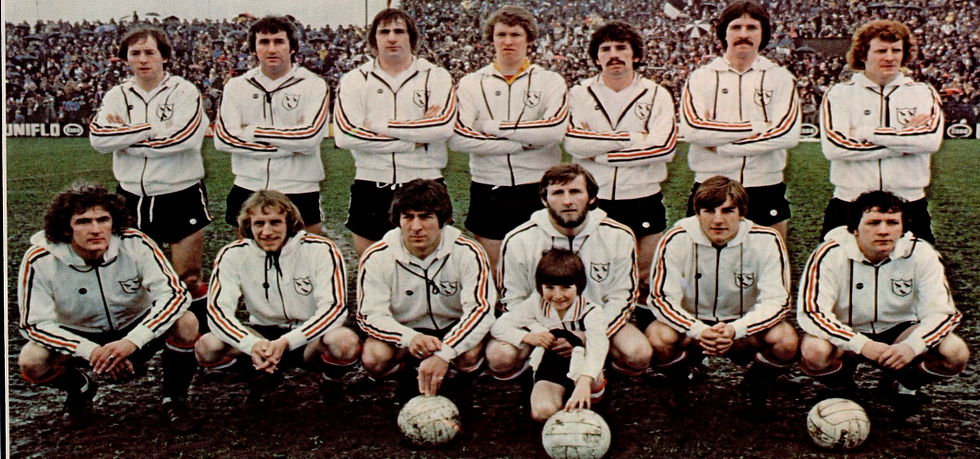
His manager's faith was repaid in full, and in the most dramatic fashion possible. In the 90th minute of the FAI Cup final, with Dundalk 1–0 up against Waterford, Carlyle brushed past defender Tommy Jackson and drove the ball home with his left foot to seal a 2–0 victory. It was the club's first-ever League and Cup double, and the image of that finish — described at the time as worthy of Roy of the Rovers — remains one of Oriel Park's most treasured memories. His 18 club goals made him the season's top scorer, with 16 League strikes placing him second only to Shelbourne's John Delamere.
The following season continued in the same vein. Four goals in the opening four League games, and one against Hibernians of Malta in the European Cup, earned him a League of Ireland representative cap against New Zealand at Tolka Park in October 1979. But cruelly, moments after opening the scoring in that match, Carlyle suffered a serious knee injury — badly torn ligaments — that would keep him almost entirely out of the game for close to two years.

He returned for the 1981–82 season alongside a new strike partner in Mick Fairclough, and the pair responded magnificently. Their combined 26 goals powered McLaughlin to a third League Championship, including a devastating four-match December run in which the two forwards scored 12 goals between them. Carlyle again proved decisive on the final day, heading home from a Leo Flanagan free-kick at St Mel's Park against Athlone Town to clinch the title in style.
The knee, however, had exacted its toll. Two further seasons brought only 16 League appearances and two goals, and in January 1984 Carlyle was released by Dundalk. He returned to Finn Harps to see out the campaign before retiring — concluding a Harps record of 105 appearances and 29 goals, and a Dundalk chapter that brought the club two League titles, an FAI Cup, a Presidents' Cup, and one indelible 90th-minute moment that supporters of a certain vintage will carry with them always.
Many thanks to the Irish Professional Footballers Benevolent Association for their assistance.


