
Paddy Turner R.I.P.

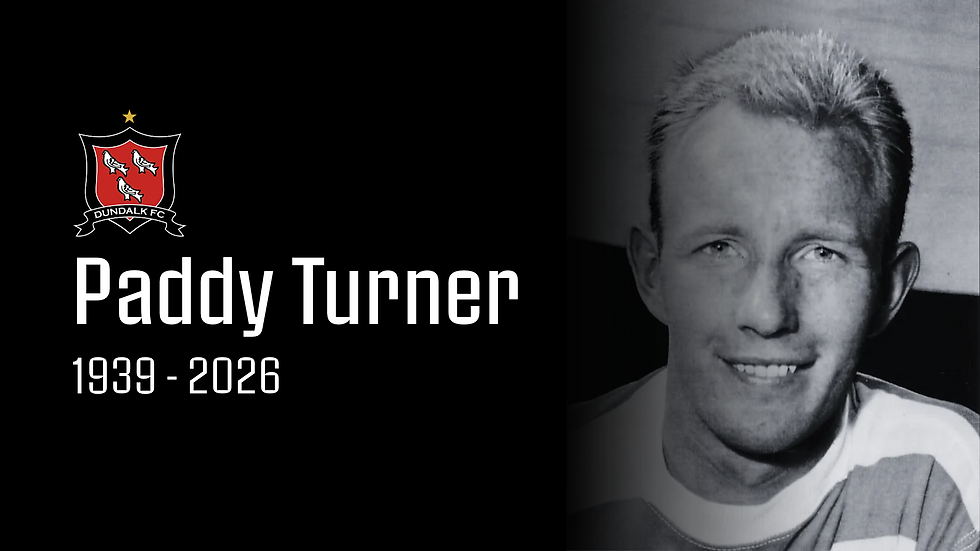
Everyone associated with Dundalk FC is saddened to learn of the passing of Paddy Turner, a gifted playmaker, a prolific goalscorer and a central figure for the club during the 1960s, who as recently as 14 July 2026 graced the pitch at Oriel Park as one of the club’s centenary legends.
Paddy played six seasons for Dundalk, from 1966 to 1972, winning seven trophies and included Shamrock Rovers, Shelbourne, Morton, Celtic, Glentoran and Bohemians among his other clubs. He also represented the Republic of Ireland on two occasions, and was named the 1969/70 Dundalk FC Player of the Year, a fitting title in a season in which he scored 21 goals, and ended the campaign as the club’s top goalscorer. Overall, Paddy played 244 times for Dundalk FC and scored 104 goals.
Jim Murphy, Dundalk FC’s famous historian who published “The History of Dundalk FC – The First 100 Years” in 2003, recalls Paddy’s great career in an article that was commissioned several years ago.
Electrician Paddy Turner was just over 18 years of age when he made his debut with the star-stuffed Shamrock Rovers during the 1958/59 season, playing on the right wing. From the South Circular Road area his under-age football was with Shelbourne nursery Saint Finbarrs, whose manager Gerry Doyle was none too pleased when Paddy ended up with the Hoops.
In the following year he first sampled European football when Rovers played Nice in the European Cup and he finished the season as Rovers second leading League marksman with nine goals, before moving to Shelbourne for the 1960/61 season.
After three opening games in the 1961/62 League campaign he was on his way to Scottish Division B club Morton in a double transfer with goalkeeper Finbarr Flood. At this stage he had knocked in 20 goals in 49 appearances with the Reds.
The two Irish lads who were flying over to Scotland for matches every weekend made an outstanding start to their Morton career with an eight-match unbroken run and finished their first season in third place, just missing out on promotion. They also collected some silverware, when defeating Saint Mirren in the Renfrewshire Cup.
In two successful seasons with Morton, Paddy found the net 22 times in 47 appearances, attracting the attention of Celtic, whose Chairman Bob Kelly was looking for the next Charlie Tully, and by the end of May 1963 he was at Parkhead. Just two weeks later he made his Irish International debut, playing at inside right when Ireland got the better of Scotland in a Dalymount Park friendly.
After making his debut on the wrong side of a 3-0 Old Firm clash, he became a Celtic first team regular at the beginning of the 1963/64 season but in an under performing team he lost his place to the young Bobby Murdoch and at the end of the season, after 14 appearances and two goals, he was transferred to Glentoran.
According to Celtic sources “he had football in him but nothing the no-plan Celtic of the time could harness to advantage”. In April 1964, before moving to the Oval, he got his second Irish cap in the Dalymount Park 2-0 loss to Spain in the World Cup.
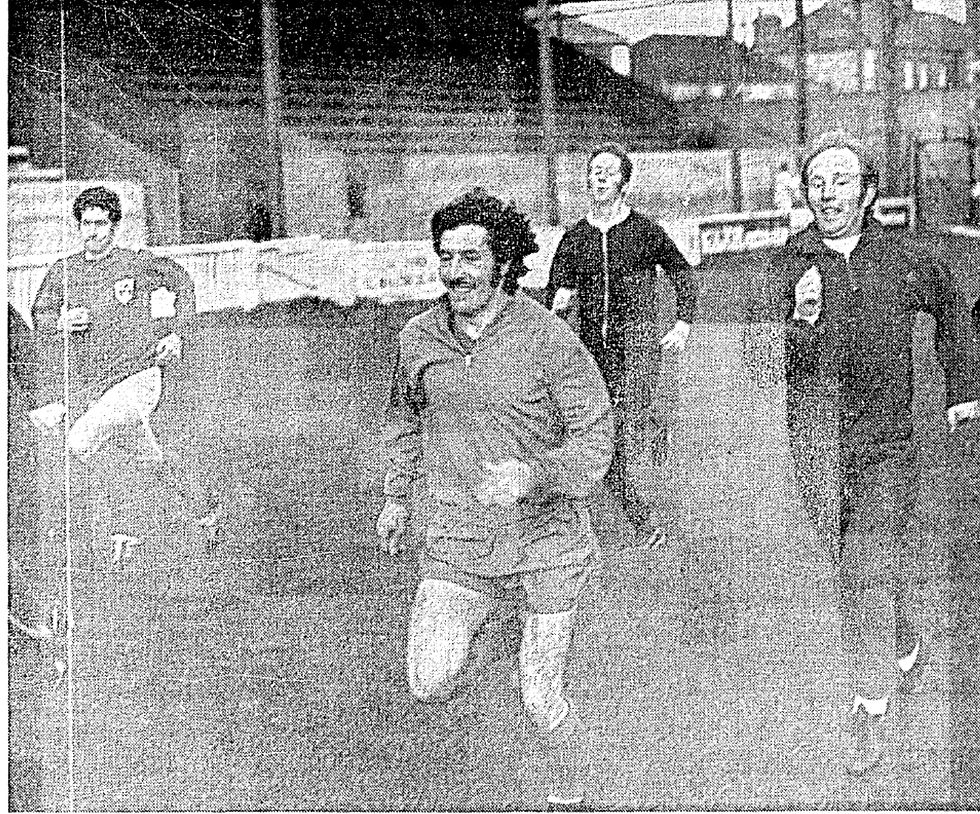
Highlights of Paddy’s first season at the Oval was Glentoran’s undefeated stroll through the 11-match Dublin City Cup, to which he contributed six goals, and a fighting performance in the European Cup against Greek club Panathanaikos when he scored in each leg in a 5-4 aggregate defeat. He was also capped by the Irish League for their October 1964 loss to the English League team.
For Oval supporters, one of the 1965/66 season highlights came in the middle of December with a victory against Distillery, clocking up the seventh successive league win and a cumulative 23 goals scored during the run. Paddy was on the top of his form, contributing four goals to the 7-3 dismantling of Distillery.
Dundalk secretary, Paddy McCourt, was alerted to the fact that Turner was becoming disenchanted with the amount of travelling from his Dublin home and in January 1966 after a season and a half with Glentoran, scoring 20 goals in 67 appearances, he became the first signing by the newly elected Dundalk Board under chairman Tom McGrath.
He quickly repaid the £500 fee, scoring on his debut in a 1-1 draw against Shelbourne, netting three on his Oriel Park debut against Drogheda and swelling the home attendances for the balance of the season.
For the unforgettable 1966/67 season under Alan Fox, which delivered a record medal haul from three victories (League, Shield and Top Four) and two sets of runner-up medals (City Cup and Leinster Cup) Paddy was a near ever present.
Until he left Dundalk over six years later his cultured performances in the inside right position played a central role in the club’s most successful period, linking up with a succession of goal-scoring partners—Danny Hale, Derek Stokes, Ben Hannigan, Turlough O’Connor—and collecting a hatful of medals.
He was no slouch himself when it came to goal scoring and before he left Oriel Park at the end of the 1971/72 season he had become the fifth player to score over a hundred club goals. He added a League of Ireland cap to his Irish League award in March 1967, when he scored in the Southerners 3-1 win at Windsor Park.
For the 1969/70 campaign, he was declared Supporters’ Player of the Year, after leading the marksman’s list with 21 goals. The recipient of the Irish Independent’s Sportstar of the Week Award in October 1966, during Dundalk’s march to the Treble, in January 1971 he received his second nomination as the Sport Star of the Week for his contribution to Dundalk’s 5-2 slamming of Shamrock Rovers in the final of the Leinster Senior Cup.
In his last club game he scored twice to give Dundalk a 2-0 half-time lead in the 1972 FAI Cup semi-final but a serious leg injury incurred by Paddy and a Waterford comeback to win 4-2 put paid to his chance of a Cup final appearance. At this stage he had all the League of Ireland competition honours except an FAI Cup medal.
He finished his career with one last season, his 15th, at Bohemians. In the three Leagues that he adorned with seven clubs over these 15 seasons, his name was on almost 200 goals and he made close to 500 appearances.
Introduced to golf when he was with Celtic and a member of Greystones Golf Club for many years, Paddy’s lowest handicap was seven and in retirement he remained a couple-of-rounds-a-week man.
Dundalk FC honours: 1966/67: League of Ireland Championship, League of Ireland Shield and Top Four Cup; 1967/68: Dublin City Cup; 1968/69: Dublin City Cup; 1970/71: Leinster Senior Cup; 1971/72: League of Ireland Shield.
Other honours at Dundalk FC: One League of Ireland cap, 1969/70 Dundalk FC Player of the Year, Irish Independent’s Sport Star of the Week: 7 October 1966 and 1 January 1971.
Everyone involved with Dundalk FC extends our deepest sympathies to Paddy’s family, friends, and former teammates at this difficult time.
Ar dheis Dé go raibh a anam.


